
Understanding blackjack starts with two simple building blocks: knowing how card values work and recognizing what your hand total means. Once you master these, reading the table and making the correct strategy decision becomes easy.
This guide breaks down card values, hand types, and provides clear, beginner-friendly blackjack hand examples that show exactly when to hit, stand, split, double, or surrender.
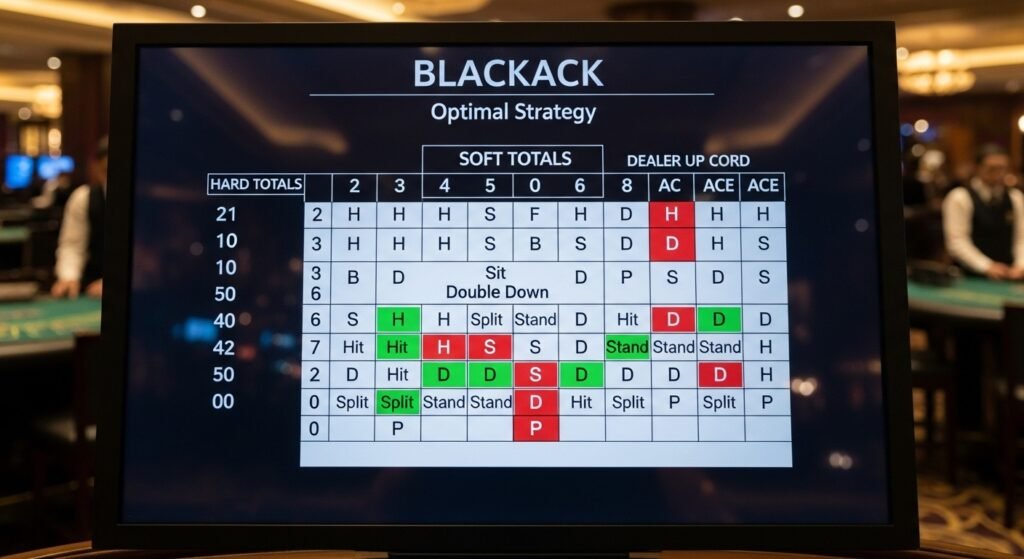
Card Values in Blackjack
Blackjack uses standard card values:
Number Cards (2–10)
Worth their face value.
Examples:
-
4 = 4
-
9 = 9
-
10 = 10
Face Cards (J, Q, K)
All worth 10.
Examples:
-
K + 7 = 17
-
Q + 3 = 13
Aces (A)
Worth 1 or 11, whichever benefits your hand.
Examples:
-
A + 6 = soft 17 (count Ace as 11)
-
A + 9 = soft 20
-
A + 6 + 10 → hard 17 (Ace switches to 1 to avoid busting)
Aces are the most flexible and important cards in blackjack.
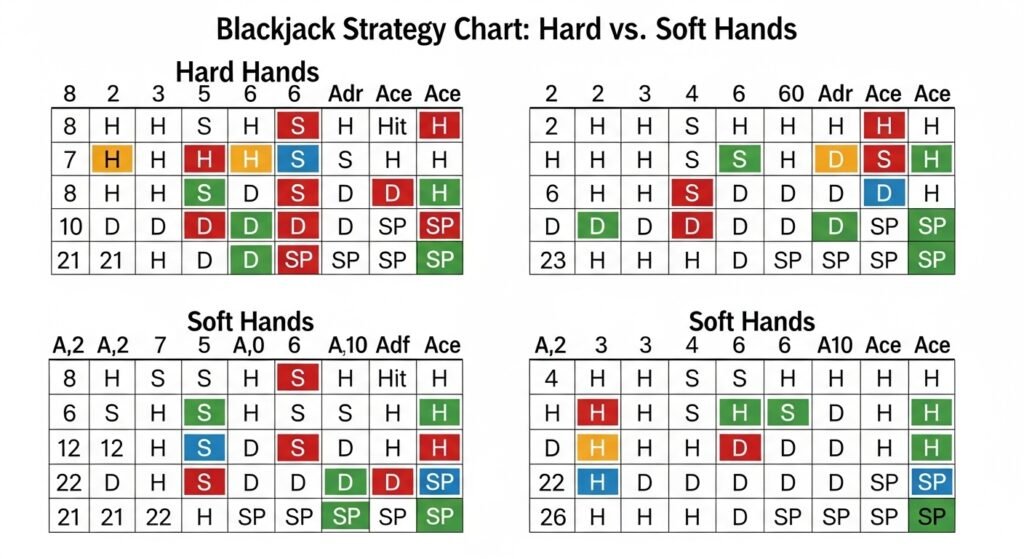
Hard Hands vs Soft Hands
Hard Hand
A hand without an Ace, or a hand where the Ace must count as 1.
Examples:
-
10 + 7 = 17
-
8 + 5 + 9 = 22 (bust)
-
A + 6 + 10 = hard 17
Hard hands are riskier to hit because they are easier to bust.
Soft Hand
A hand containing an Ace counted as 11.
Examples:
-
A + 6 = soft 17
-
A + 7 = soft 18
-
A + 2 + 4 = soft 17
Soft hands are safer to hit because the Ace can “turn into” a 1.

Why Hand Examples Matter
Most blackjack players struggle because they don’t recognize recurring hand patterns.
After you view enough examples, decisions start to feel automatic — and you stop guessing.
Below are clear, practical hand examples sorted by category.
Hard Hand Examples (Hit or Stand?)
Hard 8 or below
You should always hit. You cannot bust.
Example:
-
Hand: 3 + 5 = 8
-
Dealer shows: anything
-
Correct move: Hit
Hard 12 vs Dealer 2 or 3
Beginner trap hand. Players often stand — but shouldn’t.
Example:
-
Hand: 10 + 2 = 12
-
Dealer: 3
-
Correct move: Hit
Dealer 3 is stronger than most people think.
Hard 12–16 vs Dealer 7–A
Dealer strong → you must fight back.
Example:
-
Hand: 9 + 6 = 15
-
Dealer: 10
-
Correct move: Hit
Standing loses more over time.
Hard 17 or higher
Always stand.
Example:
-
Hand: K + 7 = 17
-
Dealer: anything
-
Correct move: Stand

Soft Hand Examples (Aces Involved)
Soft 13–17 (A+2 to A+6)
These are weak soft totals.
You should hit — and often double in the right situations.
Example:
-
Hand: A + 4 = soft 15
-
Dealer: 4
-
Correct move: Double (or Hit if doubling isn’t allowed)
Soft 18 (A+7)
One of the most misunderstood hands.
Examples:
A7 vs 2,7,8 → Stand
A7 vs 3–6 → Double
A7 vs 9,10,A → Hit
Most players stand too often with soft 18.
Soft 19–21
Almost always strong.
Example:
-
Hand: A + 8 = 19
-
Correct move: Stand

Pair Hand Examples (Split, Hit, or Stand?)
Always Split: Aces and 8s
Example:
-
Hand: A,A
-
Dealer: anything
-
Move: Split
Example:
-
Hand: 8,8 = 16
-
Dealer: 10
-
Move: Split
Two 8s make a bad 16 — splitting improves outcome.
Never Split: 5s or 10s
Example:
-
Hand: 5,5 = 10
-
Correct move: Double
Splitting ruins a strong doubling hand.
Example:
-
Hand: 10,10 = 20
-
Correct move: Stand
20 is already excellent.
Pair of 9s (9,9)
This one varies:
-
Split against: 2–6, 8–9
-
Stand against: 7, 10, A
Example:
-
Hand: 9,9
-
Dealer: 7
-
Move: Stand

Double Down Hand Examples
Doubling increases your bet, but you only get one card.
Double 10 or 11 vs dealer 2–9
Example:
-
Hand: 5 + 6 = 11
-
Dealer: 6
-
Move: Double
Double Soft 16–18 (A+5 through A+7) vs dealer 3–6
Example:
-
Hand: A + 6 = soft 17
-
Dealer: 4
-
Move: Double
Surrender Hand Examples
If surrender is allowed:
Surrender these hands:
-
16 vs 9, 10, A
-
15 vs 10
Example:
-
Hand: 10 + 6 = 16
-
Dealer: 10
-
Move: Surrender (if allowed)
Fast Hit / Stand Examples (Beginner-Friendly)
Hit
-
12 vs 2
-
12 vs 3
-
15 vs 10
-
16 vs 10
-
13 vs 7
-
A7 vs 9
Stand
-
13 vs 6
-
14 vs 5
-
15 vs 6
-
16 vs 6
-
17+ always
Quick Blackjack Card Value Table
| Card | Value |
|---|---|
| 2–10 | Face value |
| J, Q, K | 10 |
| Ace | 1 or 11 |
Conclusion
Understanding blackjack card values and recognizing common hand types is the foundation of playing well. Once you learn how hard totals, soft totals, and pairs behave, decision-making becomes easier and more consistent. With these hand examples, you’ll be able to spot patterns quickly, avoid beginner mistakes, and start playing blackjack with confidence.

Kevin Collier is the founder of BlackjackBetter.com, where he helps beginners learn blackjack in a simple, stress-free way. After years of studying basic strategy and breaking down real gameplay situations, he created this site to help new players avoid common mistakes and understand the game step by step. His writing focuses on clarity, confidence, and smarter decision-making at the table.